all models are wrong, but some are fun to play with.
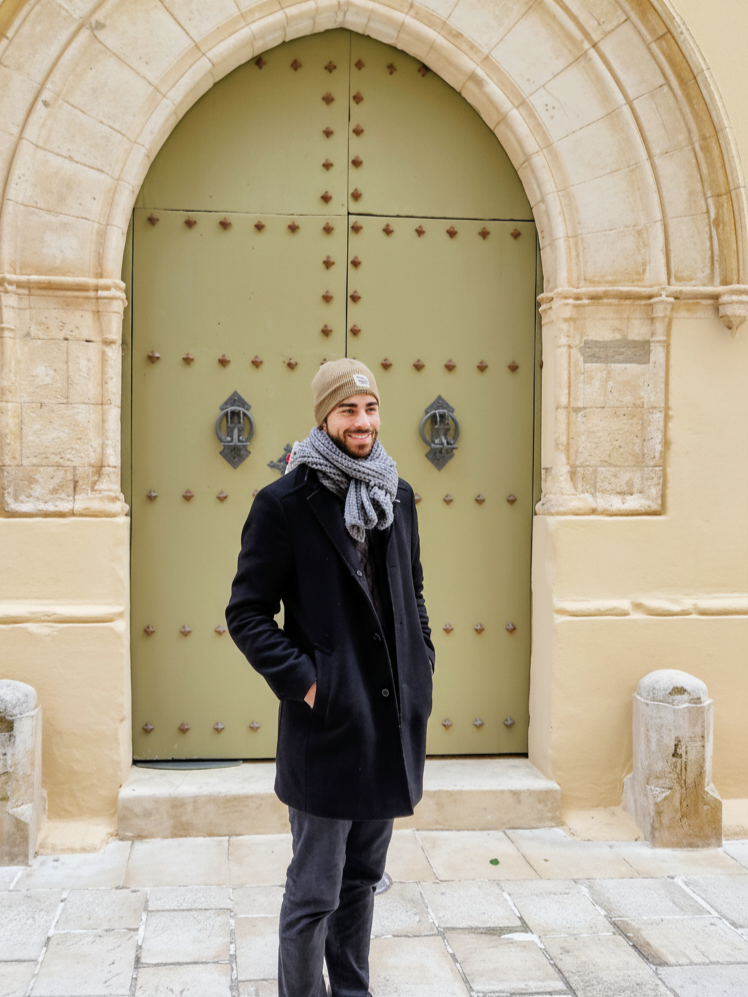
Hi there and thanks for dropping by! I'm Daniel, a researcher in global health and development.
My trajectory has been anything but linear, and over the last decade I have been doing research on obscure mathematical objects called quantum algebras, ran a leadership seminar out of an old leprosy ward in Nepal,
and developed machine learning algorithms to catch insurance fraudsters. Oh, and I almost ended up doing a PhD in neuroeconomics...but more on that below.
I'm a generalist at heart; I enjoy coding and math problems just as much as
reading several books at once and writing about anything that captures my imagination.
Such a temperament often gets in the way of becoming a subject matter expert in any domain, but I like to imagine that it lets me spot patterns and connections that specialists overlook.
If there's a thread connecting all of the above, it's probably just a stubborn commitment to understanding how things actually work, whether that's AI, quantum computing or programs to alleviate global poverty.
And why limit my curiosity to intellectual pursuits?
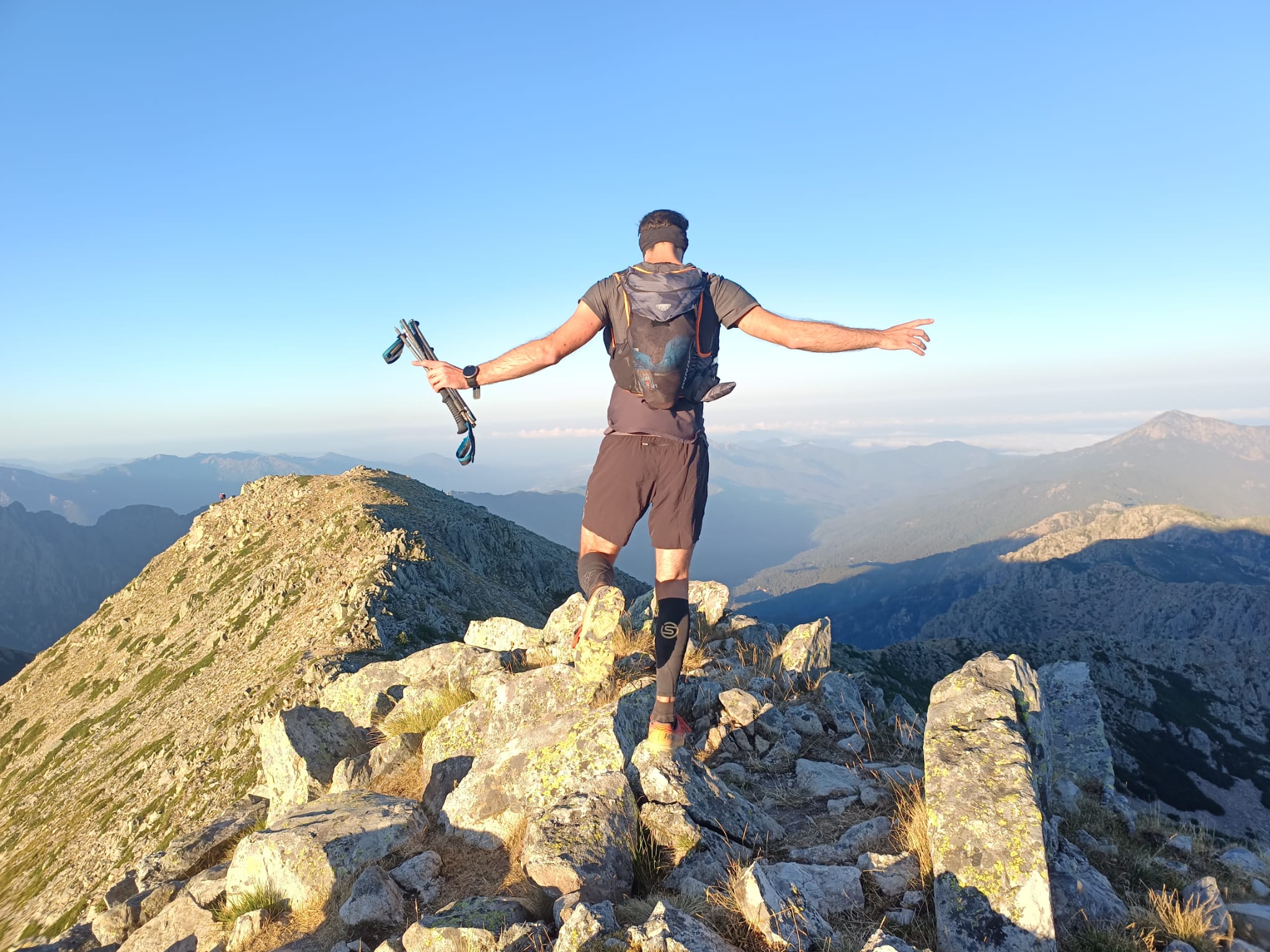
As an avid trail runner & cyclist, I'm always keen to find new ways to explore my limits, some of which I've highlighted below.
And I love connecting these exploits with traveling to new places.
Scroll on to learn more!

As a researcher at GiveWell, I explore new areas of grantmaking to expand the organization's footprint and enable them to unlock new funding opportunities. GiveWell focuses on identifying the most cost-effective programs to ensure that donations have the highest impact on global well-being. This work includes assessing the evidence behind programs, modeling disease burden, understanding the relative strengths of different actors in the field and diving into M&E data, among other things.
At Shift, I helped develop and customize an AI-powered fraud detection software for insurance companies. I managed a team that worked with major insurers in the UK and Germany, with the goal of allowing them to identify suspicious cases quickly and reliably. You can find a couple of interesting showcases at this link.
After volunteering with them for many years (during which I organized numerous conferences, talks and seminars and launched a student magazine), I joined SFL's staff full-time to expand their chapters and activities across Asia. I coordinated with student groups from Afghanistan to Indonesia, helped to establish new chapters, trained local organizers, and adapted programming for diverse cultural contexts. I'm very grateful for the many inspiring individuals I met during that time, who went above and beyond to promote a message of freedom, peaceful coexistence and open dialogue in very challenging environments.
Ludwig Maximilian University Munich & LAPTh
I was accepted into an elite master course on theoretical and mathematical physics for my graduate studies. My thesis (which you can find here) was written under the supervision of Luc Frappat and Eric Ragoucy at the Labortoire d'Annecy-le-Vieux de Physique Théorique (LAPTh). This collaboration resulted in a paper in which we showed how to construct the center of an elliptic algebra that's relevant to the study of quantum integrable systems. If all of this sounds like mumbo jumbo to you, here's my attempt to provide a non-technical, high-level overview of that work.
Ruprecht Karls University Heidelberg & Carleton University, Ottawa
I went into physics for its promise to offer a glimpse into the fabric of reality at its most fundamental level. My specialization was quantum mechanics, or, more precisely, lattice models for which the Schrödinger equation could be solved analytically. My thesis, written under the supervision of Tilman Enss, dealt with non-equilibrium dynamics (quantum quenches) of precisely such systems. As part of my undergrad degree, I also spent a year in Canada, which was a formative experience for me and something I can't recommend enough.
A selection of personal projects I've been working on. You can find more examples on my GitHub page.
How good are state-of-the-art AI models at solving coding challenges that require the clever application of mathematical insights to reduce computational complexity and avoid stack overflows?
For this project, I pitted three LLMs against each other and challenged them to generate scripts for Project Euler problems of ever-increasing complexity. The results were surprising in many ways.
A Monte Carlo model that predicts race times based on past performance and course elevation profiles for each leg of the race.
The app provides automatic integration with the Strava API to provide personalized pacing strategies. It also lets users visualize each segment and provides valuable input for your crew.
The earth is just one small planet in our solar system, and this solar system occupies just tiny part of one of the trillions of galaxies that form our universe. And yet, I've seen precious little of it. I'm using this map to remind myself that there are still many places left to be explored, just as there are many things I don't know. A couple highlights from the ones I did get to see are pictured further down.
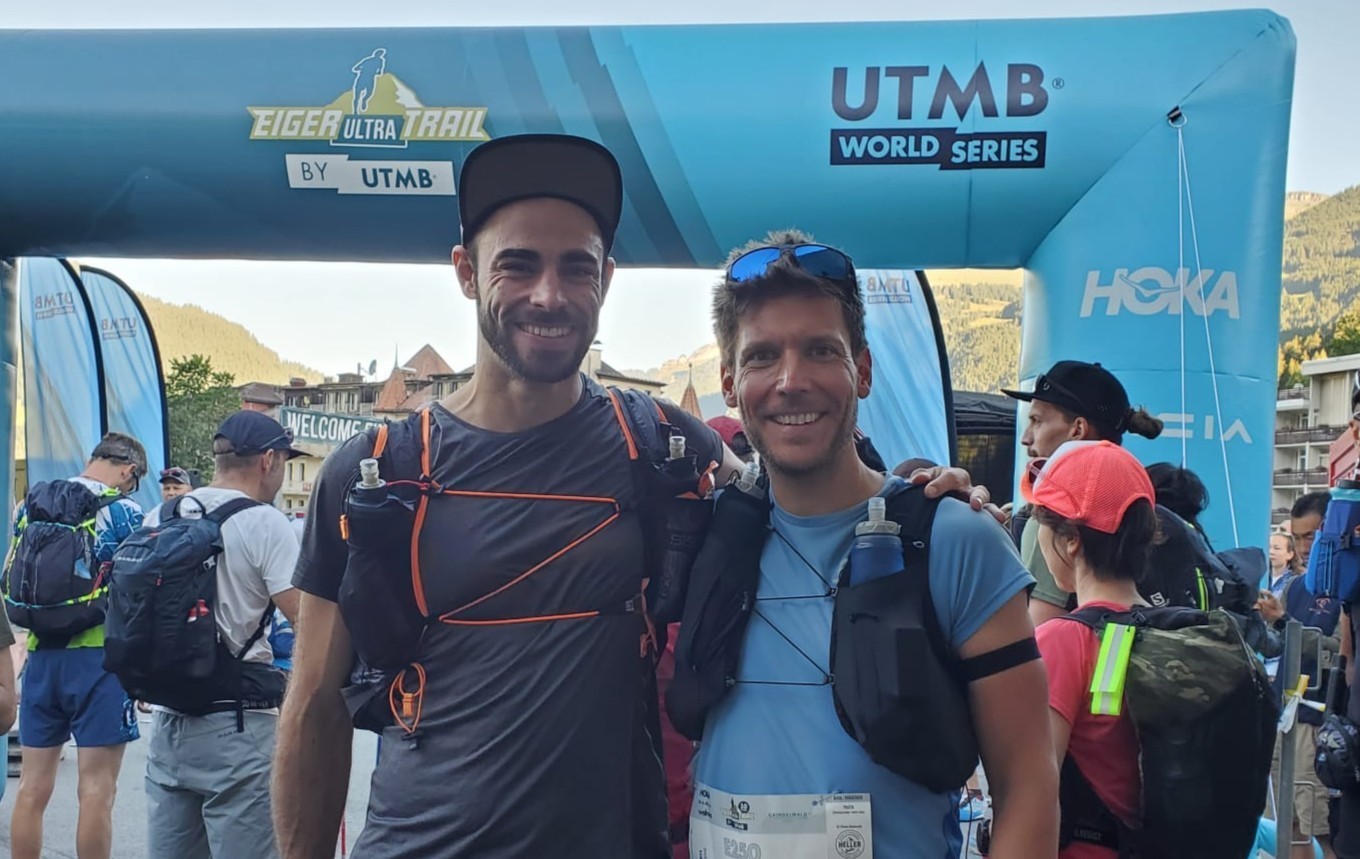
There are many ways to test one's limits, but for me, nothing beats endurance sports. Especially when you can combine it with breathtaking views! Ever since I ran my first half marathon at age 16, I've been hooked, and have finshed over 35 ultramarathons since. Below is a small selection of the most daunting, beautiful, and at times soul-crushing exploits I foolishly signed up for.
The GR20 is one of the most famous long-distance hikes in France, traversing Corsica from north to south. It's also famously rocky and technical, especially the northern section. People usually hike it in two weeks, but a friend and I decided we were going to try to finish it in four days, carrying everything on our backs. It was rough.
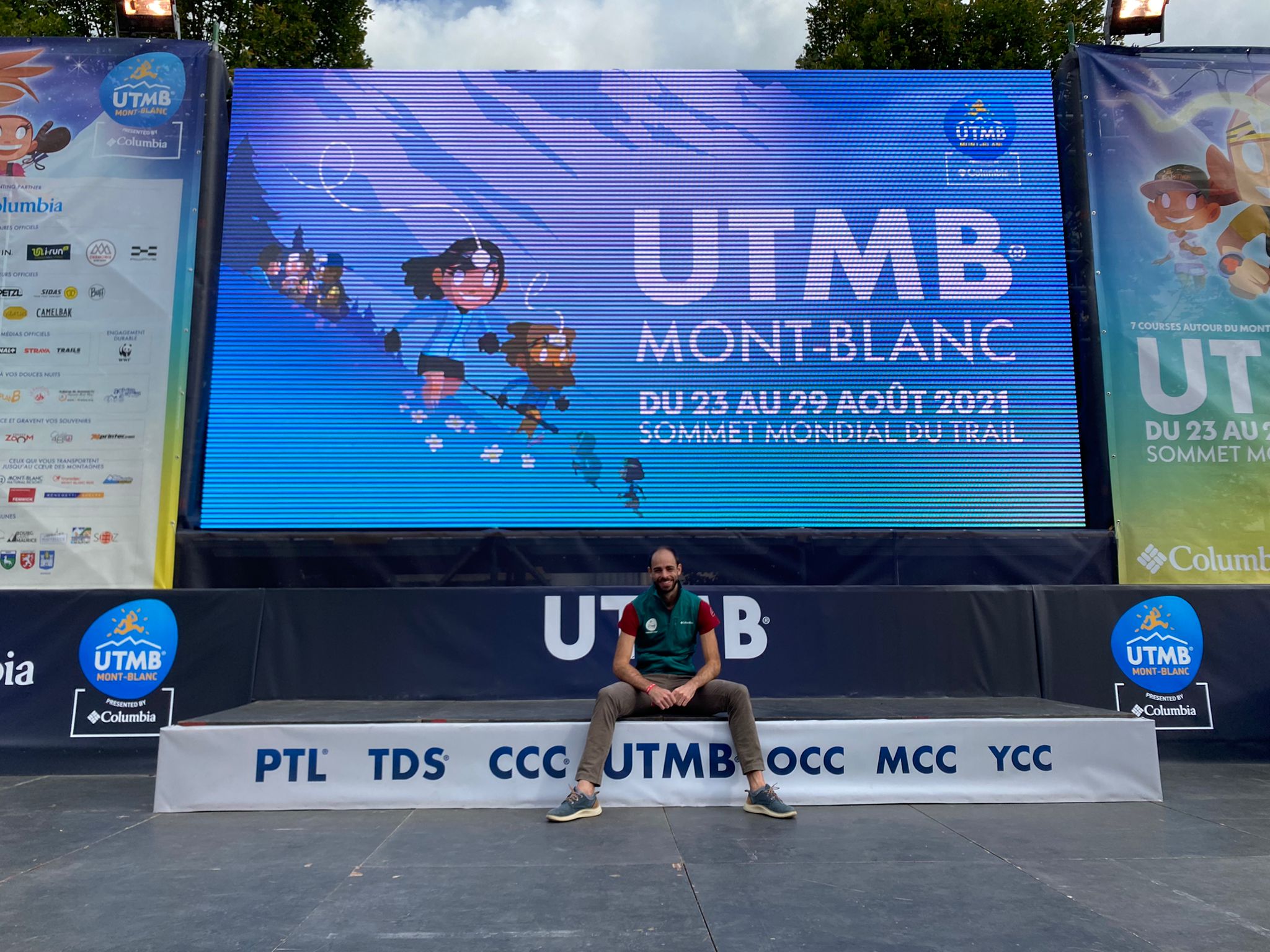
The atmosphere during the first 40km is absolutely bonkers, and the arrival after 170km is pure goosebumps. Say what you will about the UTMB group, but there's a reason why everyone wants to run it. Unfortunately, it takes a lot of time, money and luck to get into, so I doubt I'll be able to come back for a second lap. Strava link.
This remains my longest race to date. The route wraps around the famous Eiger massif and features lots of glaciers. With 260km and around 18,000m of vertical gain, this one is no joke, and we slept very little during those three days and two nights we were out on the trails. Race report.
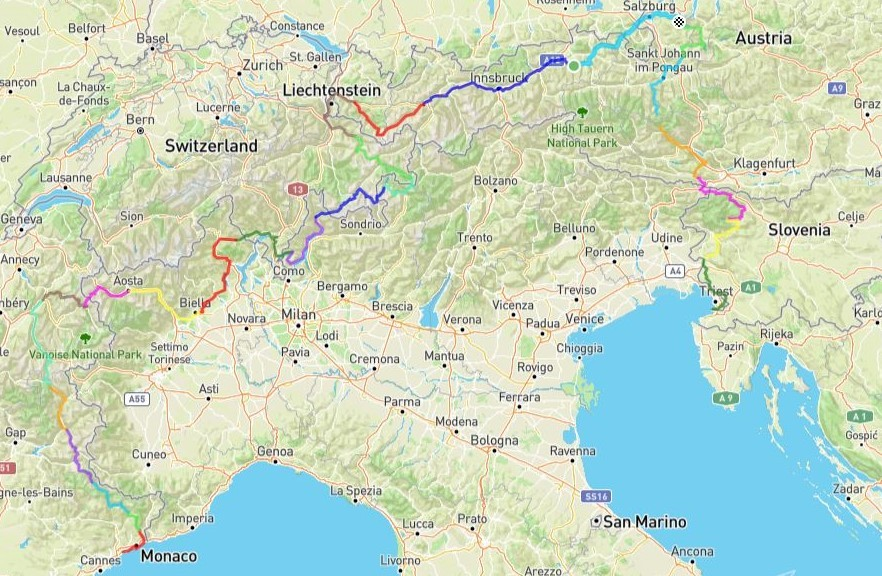
The Via Alpina is a long-distance trek that follows the Alps from Monaco to Muggia near Trieste, traversing 8 different countries. For our honeymoon, my wife and I created a bike-friendly version of this trip and spent a month climbing pass after pass. Travel log.
I love getting book recommendations from other people, so it's only fair I share mine. Of course, such a list is never static, not only because it - hopefully - keeps growing. Tastes change, insights that once seemed groundbreaking start feeling trivial, and memory isn't always as reliable as we'd like to think. But while the selection below is necessarily a snapshot of a particular moment in time, I don't think you'd regret picking up any of these. Click on them for a brief review!
The novel starts off slow and it takes a while to get into the flow, but the effort is well worth it. An absolute masterwork, for which fortunately an excellent English translation exists. It's no small feat to write 900+ pages about the life of an obscure 18th-century Jewish mystic and have the reader ask for more at the end.
I've never read a Vargas Llosa novel I didn't like, but his exploration of power and corruption through the lens of Rafa Trujillo's dictatorship may be the best of them all. Vargas Llosa was well-known as one of the powerful critics of left-wing authoritarianism in Latin America, but The Feast of the Goat proves that he was not ignorant of the right's illiberal, repressive tendencies either. A gripping read from start to finish.
This is not the book you pack for a summer vacation on a tropical beach. It is an attempt to pour the "banality of evil" into literary form by revisiting the horrors of the Second World War through the eyes of an SS officer. Dense, full of gratuitous, mind-numbing cruelty, Littell has created a tome that is designed to make your stomach churn.
I read "The Magic Mountain" way back in high school, and the novel has had a special place in my heart ever since. It is a nostalgic work, portraying the sanatorium as a microcosm of European culture and thought before the continent descended into the madness of two world wars. And, of course, it's the paradigmatic TB novel, a disease that has faded from collective memory in the West but continues to claim the lives of more than a million people each year.
I like to think of Franzen as the 21st century reincarnation of John Updike, and both have certainly contributed much to the tradition of the suburban novel. The conflicts that form the backbone of The Corrections will hit close to home for many readers, and their very futility makes the book so gripping. Read it for glimmers of hope amidst much self-imposed misery, inexplicable behaviors that only gradually begin to make sense, and astute psychological observations of emotional turmoil.
To understand what it means to seek power for power's sake, look no further than Warren's fictionalized account of Louisiana's governor Huey Lewis. There are things a novel manages to capture that no study of populism, however comprehensive, could convey.
Irving is an excellent storyteller - not because he's groundbreaking or innovative (David Copperfield is an obvious influence, as is Goethe's Wilhelm Meisters Lehrjahre), but simply because he's perfected the craft of telling a great story. It's probably the best and most nuanced literary treatment of abortion, neither shying away from judgment nor suppressing its complexities.
A multigenerational saga of two families in California's Salinas Valley, centered on the Trasks and their recurring struggle with jealousy, rejection, and the question of how our parents' deeds shape our own lives. It's one of the few books I just couldn't put down - the prose is so, so good.
Faust I represents for German culture what Hamlet is to British, Don Quixote is to Spanish and The Divine Comedy is to Italian literature. Of course you should read it in the original, if you can. Unlike some of the other classics, it's fairly short and actually quite accessible.
Camus' most famous work chronicles a plague outbreak in Algeria with the detached precision of a medical report. The flatness of the prose is the point: no heroics, no melodrama, just people struggling with an invisible enemy. Written in the shadow of the Nazi occupation, it can either be read as an allegory, or - as many have done during the Covid-19 pandemic - in a very literal way. Either way, it's wonderfully somber and haunting.
Is this the only one of Houellebecq's novel in which he makes a cameo appearance (mostly just to get murdered - a deed he's not nearly as bothered by than the fact that it was unrelated to anything he'd written)?. Anyway, the real subject is France itself: a country transformed from industrial powerhouse to glorified tourist destination, populated by people who've achieved comfort but lost any larger sense of purpose. In other words, it's quintessential Houellebecq — mordant, detached, and funnier than you'd expect it to be.
Oz' magnum opus paints a tragical yet hopeful picture of the early days of Isreal. It's the story of his high bourgeois, Eastern European ancestors who move to Mandatory Palestine in the wake of the Holocaust, and tried to build a new existence in a country that had little in common with the place the grew up in. The book's themes are as relevant as ever, especially Oz' wonderful portrait of the shared humanity of all the different people inhabiting the region.
The first chapter is some of the best fiction I've ever read - a sprawling, fantastical, mind-boggling stream of associations that is delivered with such force it makes you wonder what substances Labatut must have meditated on. The rest of the book is not quite as strong as the opening, but it's still a marvelous achievement.
McCarthy is something like the Impossible Burger of fiction writers - even people who claim to hate literature love his prose. Of all his books, I liked The Road best - it's mesmerizing, almost hypnotic, barren, totally non-condescending, and hard to put down once you get going.
A harrowing read. There sure are books that portray greater evil and tragedy than this Newark family drama, but for reasons I can't quite articulate, watching the life of a successful businessman and father unravel through no fault of his own (or so it appears). Roth's best novel, in my mind (and he wrote many excellent ones) - he was truly at his zenith in the late 90s.
This wonderful little book sets out to answer two questions: Why did reason evolve in the first place? And why does it so often lead us astray? Their approach is an engaging and sometimes controversial defense of the claims that reason can only be understood in a social context.
Politics and religion are the two topics not to be discussed in polite society. What this piece of advice is based on and how we might be able to do better in an increasingly polarized society is the topic of Haidt's classic book. Not everything in it has stood the test of time (e.g. his "Moral Foundations" theory seems to have major replication issues), but it remains a standout work to help us appreciate our own blind spots a little more.
Take it from Martin Gardner: "Every few decades, an unknown author brings out a book of such depth, clarity, range, wit, beauty and originality that it is recognized at once as a major literary event." The field of AI has changed tremendously since GEB was first published, but the book has aged surprisingly well. A must-read for anyone who is fascinatrf by how mind emerges from matter.
Nothing in biology makes sense except in the light of evolution, and illnesses & diseases are no exception to that rule. Of course the insight that pathogens, too, struggle mightily to increase their fitness, is not novel, but the question why the human body hasn't found its way around non-infectious diseases (especially mental illness) remains a puzzling one. I credit this book with giving me a new and refreshing outlook on medicine.
Henrich's core claim is that much of what makes humans successful isn't individual intelligence but our ability to copy others and accumulate cultural knowledge we don't fully understand. The discussion of how people "figured out" how to detoxify poisonous cassava alone makes this worth reading. The uncomfortable (for some people, anyway) implication is that traditions often encode solutions to problems we can't consciously articulate, and "rational" attempts to optimize them can backfire.
Scott frames state formation as a grand exercise in making society legible, by standardizing local customs, measures, and property systems so they can be taxed and conscripted from. My favorite example is the window tax, which attempted to measure house values by counting windows (with predictable architectural consequences). His point isn't that standardization is always bad, but that we're too quick to dismiss local practices as irrational.
This is probably the best book for curious laypeople to get a deeper understanding of genetics. Mukherjee is one of the most gifted science writers of our age, and here he does a wonderful job of relying complicated concepts in an accesible (but not simplistic) way.
Optimists are often accused of having an irrational, panglossian view way of looking at the world, but Ridley makes the case that it's the pessimists who are mistaken and selective in their assessment. There is now a whole community dedicated to the study of progress, but The Rational Optimist still strikes me as the best exposition of this view.
Not a gripping read and no grand theory, but a wonderful exploratory tour of the variety of public agencies and the bureaucrats that staff them. Especially libertarians should give this a read, and ask themselves whether cynicism about the public sector is really all they want to offer. Like it or not, bu the usual market remedies don't translate: we sometimes want bureaucracies to be inefficient!
In most everyday sitations, a honeybee is a nuisance, and few people other than professional melittologists think there's much to be gained from studying them. Seeley's remarkable accomplishment is that he demonstrates how fascinating things get when you look at the decision-making processes of a swarm as a whole, with important implications for neuroscience and collective action theories. If nothing else, knowing how a swarm finds a new home is excellent cocktail party knowledge.
David Friedman strikes me as the sharpest thinker among the more radical libertarians. You don't have to buy his arguments in favor of market anarchism to find the book thought-provoking. What I particularly liked about it is that, even though his challenges for political philosophers of all stripes are excellent, he's very open about the shortcomings of his preferred political system.
World War I was arguable the defining moment of the 20th century, putting an end to the old imperial order and laying the groundwork for the emergence of facism, national socialism and communism. How could what started as a small regional conflict spiral into a devastating, all-out global conflict with millions of casualities? Clark's controversial (but well-argued) thesis is that Europe indeed sleepwalked into this war: Trench warfare became reality not so much as a a result of geopolitical ambitions as out of sheer incompetence among Europe's ruling class
Among the myriad books that have been written on hidden motives that guide our thinking and decisions, this one stands out. Once you understand their point about self-deception and how it permeates every aspect of society, you'll never the the world through the same eyes again.
Poor Economics is, at its core, a highly empathic attempt to come to grips with the seemingly paradoxical and self-defeating everyday choices of the world’s poor. It’s also a prime example of a work that engages those who disagree with its perspective in good faith. Not to mention that it has also been a major driver of the credibility revolution in development economics. No small feat for such a relatively slim volume!
Language is often cited as the prime example of a complex emergent system or spontaneous order, but what exactly does this mean, and how did it emerge? Deutscher's book is simply the best introduction to understand how, practically speaking, language was created from a pretty rudimentary system of verbal cues, without anyone intending the final outcome we use today. Needless to say, its lessons are underappreciated by the diverse groups out there that try to shape language in their preferred image.
For the complete list of what I've read and what's on deck, see my Libib collections.
Have a question, got feedback or simply want to get in touch? I'd love to hear from you!